Category: Righteous Innovation
Year: 1968
Pioneer: Tommie Smith and John Carlos
Country of Origin: United States
Introduction
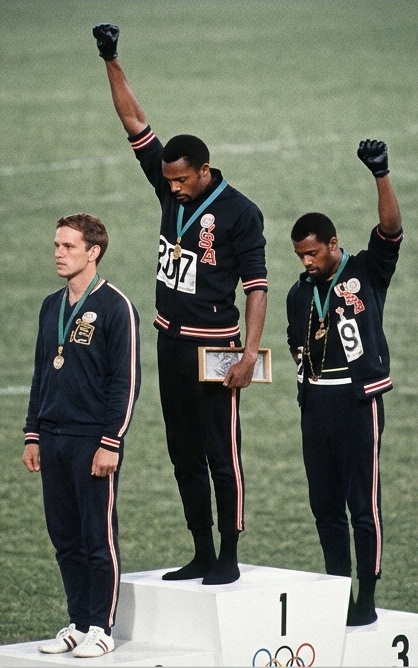
The Black-Gloved Protest at the 1968 Summer Olympics stands as one of the most powerful acts of moral courage in modern sports history. On October 16, 1968, American sprinters Tommie Smith and John Carlos raised their gloved fists during the medal ceremony for the 200-meter race, silently protesting racial injustice and inequality in the United States.
Born out of the broader Civil Rights Movement, their act symbolized solidarity with oppressed communities and called global attention to systemic injustice. Smith, who won gold, and Carlos, who won bronze, used the international stage not for personal glory, but for moral witness. Their gesture cost them their Olympic careers, subjected them to public backlash, and placed their personal safety at risk.
Yet, their legacy endures as a pioneering moment in sports activism—transforming athletes from performers into voices of conscience. This event is recognized ias both a Righteous Event and a Righteous Decision, marking the first iconic instance of athlete-led moral protest on a global stage.
Table 1. Timeline of the 1968 Black-Gloved Protest
| Year | Event |
|---|---|
| 1967 | Formation of the Olympic Project for Human Rights advocating racial equality in sports |
| 1968 (Oct 16) | Tommie Smith wins gold and John Carlos wins bronze in 200m race |
| 1968 (Oct 16) | During medal ceremony, both athletes raise black-gloved fists in silent protest |
| 1968 (Oct 17) | Suspended and expelled from Olympic Village by International Olympic Committee |
| 1968–1970s | Face backlash, threats, and professional consequences |
| 2005 | Statue honoring the protest installed at San Jose State University |
| Present | Widely recognized as a defining act of athlete activism |
Table 1 presents a chronological overview of key events leading to and following the protest at the 1968 Summer Olympics, highlighting critical moments that shaped this historic act of moral courage and athletic activism.
Table 2. The Righteous Events, Decisions, and Acts
| No | Event / Decision / Act | Context | Righteous Quality Demonstrated |
|---|---|---|---|
| 1 | Joining the Olympic Project for Human Rights | Athletes organized to protest racial injustice globally | Collective moral awareness |
| 2 | Deciding to protest on the podium | Risking careers on the world’s largest stage | Moral courage |
| 3 | Wearing black gloves | Symbol of Black strength and unity | Symbolic resistance |
| 4 | Raising fists during national anthem | Silent but powerful global message | Courage under scrutiny |
| 5 | Removing shoes, wearing black socks | Representing Black poverty in America | Empathy and advocacy |
| 6 | Wearing human rights badges | Solidarity with global justice movements | Unity beyond self |
| 7 | Refusing to retract the protest | Despite backlash and threats | Integrity |
| 8 | Accepting expulsion from Olympics | Immediate punishment for moral action | Sacrifice |
| 9 | Enduring public criticism and threats | Social and economic consequences followed | Perseverance |
| 10 | Continuing advocacy after careers | Lifelong commitment to justice | Enduring righteousness |
Table 2 outlines the major actions taken by Tommie Smith and John Carlos, illustrating how each decision reflected principles of justice, sacrifice, and innovation, establishing a pioneering model of righteous protest in global sports history.
Hard Times: Trials That Tested Their Righteousness
The protest brought immediate and severe consequences. Rather than being celebrated, Smith and Carlos were condemned, ostracized, and punished. Their righteousness was tested not only in the moment of protest but in the years of hardship that followed (see Table 3).
Table 3. Major Life Challenges and Hardships
| Hardship | Description | How Righteousness Was Tested |
|---|---|---|
| Public backlash | Labeled unpatriotic and controversial | Tested their commitment to truth over approval |
| Expulsion from Olympics | Removed from Olympic Village and banned | Immediate consequence for moral action |
| Career loss | Athletic opportunities diminished | Sacrificed personal success |
| Death threats | Faced threats against themselves and families | Courage under real danger |
| Financial hardship | Struggled economically after protest | Endurance and resilience |
| Social isolation | Criticized by media and public figures | Standing firm despite rejection |
Reflection
What does the Black-Gloved Protest teach us today?
In a world where athletes are often encouraged to “stick to sports,” Tommie Smith and John Carlos redefined the very meaning of athletic greatness. They understood that true victory is not only measured by medals, but by the courage to stand for what is right.
Their act was not loud, violent, or disruptive—it was silent, dignified, and deeply moral. Yet it shook the world.
As pioneers of righteous innovation in sports, they demonstrated that the field of competition can also be a platform for conscience. Their legacy paved the way for future generations of athletes to speak out on issues of justice, equality, and human dignity.
The Black-Gloved Protest remains a timeless reminder that righteousness is not confined to personal conduct—it can reshape entire systems, redefine roles, and inspire the world.
References
Tommie Smith, & John Carlos. (2007). Silent Gesture: The Autobiography of Tommie Smith. Temple University Press.
John Carlos. (2011). The John Carlos Story: The Sports Moment That Changed the World. Haymarket Books.
International Olympic Committee. (n.d.). Olympic Games Mexico City 1968 Overview. Retrieved March 29, 2026.
Olympic Project for Human Rights. (1967). Founding principles and protest documentation.
San Jose State University. (2005). Tommie Smith and John Carlos Statue and Legacy Program.
Smithsonian National Museum of African American History and Culture. (n.d.). The 1968 Olympic Protest.
Encyclopaedia Britannica. (n.d.). 1968 Olympics Black Power Salute.